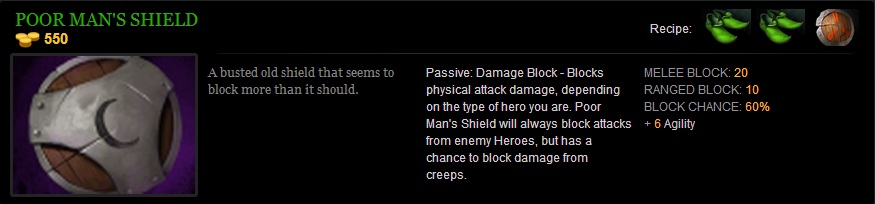
Poor Man's Shield

If you’ve played Dota, then you’d know an item called Poor Man’s Shield. Without getting too much into the meta and expose my laughable understanding of the game, the item is mostly about cost efficient way to deal with relatively tough situations in the early game, without the late game resources to go for a more luxurious option right away (except when you can stomp in early game against noobs like me).

In web development, there can be tough situations as well. One situation I encountered recently was to load potentially thousands of items each with multiple charts on a single page, in a nutshell:
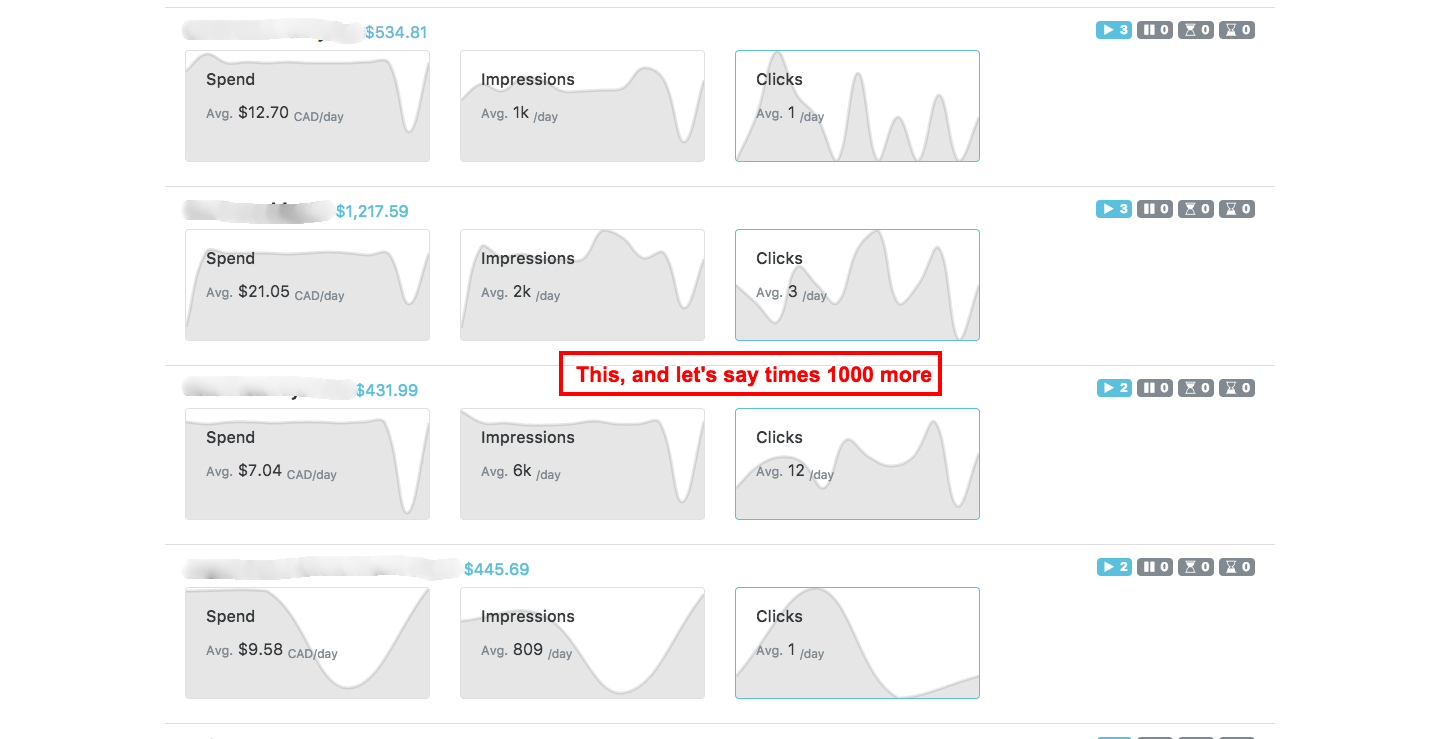
So Many Charts

In this post, I’m going to walk through my steps of developing the poor man’s approach to handle the tough situation. For examples below, we are going to utilize Vue.js v2 as the data binding layer, and Chart.js v2 for chart.

Be Naive

Starting with the most naive approach:

1
2
3
4
5
6
7
8
9
10
11
12
13
14
15
16
17
18
19
20
21
22
23
24
25
26
27
var app = new Vue({
//... other configurations
components: {
chart: {
template: '<canvas :height="height"></canvas>',
props: ['height', 'data', 'options', 'type'],
methods: {
render: function(el) {
var self = this;
self.chart = new Chart((el || self.$el).getContext('2d'), {
type: self.type || 'line',
data: self.data || {
labels: [],
datasets: []
},
options: self.options || {}
});
}
},
mounted: function() {
var self = this;
// initialize the chart
self.render();
}
}
}
});

(fully working jsfiddle)

This works. However it becomes royally painful to load when you have so many items as the situation I described earlier. In fact, just a mere hundred of such items on a single page already causes unpleasant amount of time to render while showing a blank page, and blocking all user interactions except inviting end users to force close the browser/tab due to frustration (and probably never getting them back). Such horror is not tolerable on today’s internet.

Be Asynchronous

One way we can make this better is to explicitly instruct the component to asynchronously initialize the chart through the use of setTimeout:

1
2
3
4
5
6
7
8
9
10
11
12
13
14
15
var app = new Vue({
//... other configurations
components: {
chart: {
//... same component configurations as above
mounted: function() {
var self = this;
// asynchronously initialize the chart
setTimeout(function() {
self.render();
}, 0);
}
}
}
});

(fully working jsfiddle)

This approach effectively causes Vue to render the charts in the “next” update cycle. It makes the UI a bit less painful to use as there can be some “primer” contents rendered, which usually exhibit as a part of the parent elements that hold the chart component. However, this is not good enough, as the deferred update cycle would still block the whole UI. This is especially bad when the page offers many items in a list fashion that the users would want to either search with CTRL/CMD + F or scroll down for items that are out of the current view. Besides, it’s very wasteful to render things that cannot even be seen yet.

Be Lazy

This leads to a tried and proven technique many refer to as “lazy-loading”. With so many years of such technique being matured, and thanks to the ever so successful open source community, one can easily pick a robust library that does it well while being delightfully simple to use. The following is an approach with one such library called ScrollReveal:

1
2
3
4
5
6
7
8
9
10
11
12
13
14
15
var sr = ScrollReveal();
var app = new Vue({
//... other configurations
components: {
chart: {
//... same component configurations as above
mounted: function() {
var self = this;
sr.reveal(self.$el, {
afterReveal: self.render
});
}
}
}
});

(fully working jsfiddle)

It’s pretty amazing now, the component rendering get deferred until they are needed by the end users.

Extra

After handling the situations for the sake of end users, let’s make a final touch to give some options for the users of this component to have control over the render flow, for example:

1
2
3
4
5
6
7
8
9
10
11
12
13
14
15
16
17
18
19
20
21
22
23
24
25
26
27
var sr = ScrollReveal();
var app = new Vue({
//... other configurations
components: {
chart: {
//... same component configurations as above
props: [
'height', 'data', 'options', 'type',
'flow' // let's add a 'flow' parameter
],
mounted: function() {
var self = this;
if (self.flow == 'sync') {
self.render();
} else if (self.flow == 'async') {
setTimeout(function() {
self.render();
}, 0);
} else {
sr.reveal(self.$el, {
afterReveal: self.render
});
}
}
}
}
});

The flow parameter allows 3 modes, let’s go by imaginary use cases:

  • sync would be used when this chart component is nested under another component (which hopefully already applies some sort of render deferring optimization similar to what we’ve done thus far), and requires the chart to visually appear at the same time as its parent component
  • async is very similar to sync, except that we don’t require the chart to visually appear at the exact same moment as its parent component.
  • The third and the default mode would be the self-contained optimal approach that we worked out from above.

There’s room for more sophistication. One can wrap the above into an easy-to-use custom directive or wrapper component, or even directly make it into Vue.js, making it more of an “end game” approach. With some twist, this approach can also be adapted into other choices of data binding layer and chart library.

But there’s always the option to employ the poor man’s approach – simple, effective, easy to understand and not too shabby to apply to any existing applications of any scale.

Programming can be enjoyable, but not always so. I bet even those who claim to be the most passionate about programming suffer from impossible deadlines, technical difficulties and other causes. As a programmer, I certainly don’t want to have my final moment like this:

You see, when you lie on your death bed, you will look deep into your wife’s eyes, and think of all those lovely moments you spend in Visio drawing UML diagrams and writing clean, simple and maintainable code…
Stack Exchange User 11170 - https://programmers.stackexchange.com/a/114888/95830

Read more »

Over the time of learning and practicing various programming techniques, on personal and organizational projects, I have developed a discipline on the way I code - I should code for my users.

Read more »

In a recent project, I needed to maintain quite a number (8-9 and growing) of charts that support “real-time” data updates (1 second interval) on a single page. The following open source libraries are what I have tried.

Read more »

I had a simple problem along the way of exploring Node.js, which involves writing modules that work for both server and client sides. Just like many programmers nowadays, I google’d out a solution (which was written by the person who authored async, so I guess I need to thank him at least twice).

However this doesn’t solve all my problem since I am way too lazy to get rid of all those amazing open source libraries.

Read more »

“Yes, you have my full attention right now.”

TL;DR: Archive emails (ham), with discipline.

Read more »

I have been toying around with a few ideas lately, the process allowed me to tackle some interesting problems by ways that are not so conventional, at least not the ones from Google page 1’s.

Read more »

I was joking the other day, that by looking at the current Ubuntu version number, one could realize how fast time goes by.

Though I believe these time based concepts are just illusions that human beings created, that I would rather not let them clutter my mind as other unworthy things, they matter in the real world, or meta world that I would like to call it.

Read more »

It was about the same time when I got into the amazing worlds of programming and strategy games, when I was about 16 years old.

Ten years later, I’ve figured out some astonishing similarities between them.

Read more »

Previously, we discussed the possibility to hack PycURL to achieve somewhat a more controllable HTTP streaming client.

Today, let’s add some Redis ingredients into our recipe and make this tool more controllable so that we can solve the remaining problems aforementioned.

Read more »
0%